- Eye Health
For the first Global Summit for Eye Health on 2 November 2026, Light for the World is committing to invest US$15 million by 2030 to advance equitable and disability inclusive eye care for more than 3.5 million people in Burkina Faso, Ethiopia, Mozambique and Uganda. Read Light for the World’s full Summit commitment.
Our Global Summit for Eye Health Commitment
By 2030, Light for the World aims to reach more than 3.5 million people in Burkina Faso, Ethiopia, Mozambique and Uganda. We commit to:
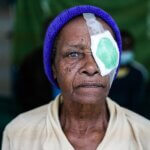
- Support more than 100,000 cataract surgeries, helping people regain their sight
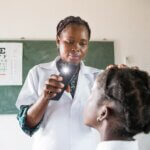
- Screen more than 1 million children for eye conditions
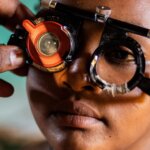
- Provide more than 10,000 corrective eyeglasses to people with refractive errors
- Train more than 5,000 eye care practitioners, general health workers and community health workers
- Contribute to eliminating blinding trachoma by reaching 2.5 million people through mass drug administration (MDA) with antibiotics and supporting 6,500 trachomatous trichiasis (TT) surgeries
- Strengthen access to services for rare and complex eye diseases
- Contribute to increased effective refractive error coverage (eREC) and effective cataract surgical coverage (eCSC) across supported programmes
The work prioritises people who face the greatest barriers to eye care, and addresses the gender and disability related inequalities through gender and disability-responsive training and the use of sex, age and disability disaggregated data.
Read the full commitment: US$15 million for inclusive eye health by 2030
Get in touch about partnership opportunities
Light for the World has set a commitment to bring eye care to 3.5 million people by 2030 and we are seeking partners to help make this a reality.
To discuss how your organisation can lead this work and help us reach our goal of US$15 million contact Noumi Oosterwijk at n.oosterwijk@light-for-the-world.org.
Our impact
Our work focuses on strengthening accessible, sustainable eye health systems, training local eye health specialists and eliminating neglected tropical diseases (NTDs).
Our Child Eye Health Programme
“1,2,3 I Can See!” is Light for the World’s flagship child and school eye health programme, working with ministries of health and education to reinforce child eye health systems in Burkina Faso, Ethiopia, Mozambique and Uganda.
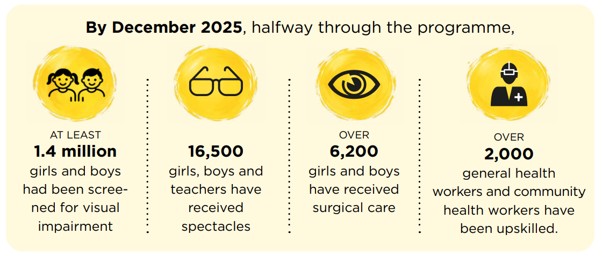
Read more about our support for the unsung heroes of child eye quietly transforming child eye health in Africa and the pioneering paediatric ophthalmologists leading the drive to save children’s eyesight in their countries.
Combatting neglected tropical diseases (NTDs)
Together with our partners, we are working to eliminate three NTDs: trachoma, river blindness and lymphatic filariasis. Focusing especially on preventive treatment, we limit their spread through:
- Raising awareness and providing clean water and sanitation facilities
- Providing medicines
- Case detection, case management and improved vector control
Learn more about our work and why investing in NTDs matters.
Media features
The New York Times profiled paediatric ophthalmologist Dr Isaac Vasco da Gama and his pioneering work on child eye health in partnership with Light for the World. Read the New York Times article on child vision in Mozambique.
Dr Claudette Yaméogo, Burkina Faso’s only pediatric ophthalmologist, whose training was supported by Light for the World, was profiled by the Associated Press (AP). Read the AP article.
Ophthalmologist Dr Geoffrey Wabulembo told El País about the barriers to cataract surgery for people in sub-Saharan Africa. Read the El País article (in Spanish).
Resources
Light for the World takes a comprehensive approach to eye health, working with partners and authorities to strengthen national health systems and integrate eye health into universal health coverage plans.
Learn more in our Eye Health Policy Brief.
We believe in a world where people with disabilities and eye conditions can fully exercise their rights. Institutional and local partners are key to delivering this vision.
Read our Working with Institutional Partners Issue Paper and Working with Local Partners Issue Paper to learn more about how we work.