- Economic Empowerment
The PowerUp Programme is transforming a mounting e-waste problem into skills, income and opportunity for entrepreneurs with and without disabilities.
From smashed smartphones and faulty cookers to broken computers and worn-out chargers, Kenya has an electronic waste problem.
The country generated a record 55,956 tonnes of e-waste in 2025 — the equivalent weight of more than 9,000 adult elephants.
While many of the products can be repaired or repurposed, less than 1 per cent of e-waste is formally collected and recycled, leaving the majority to enter informal disposal networks.
The PowerUp Programe is tackling that growing mountain of e-waste — promoting inclusive entrepreneurship by expanding opportunities for women, youth and people with and without disabilities across the e-waste value chain.
E-waste entrepreneurs collect, repair and repurpose electronic products, creating businesses around products that would otherwise be thrown away and contributing to the growth of the circular economy in Kenya.
Implemented by Bopinc and Light for the World Kenya, the PowerUp Programme has trained 2,187 young entrepreneurs across six counties, including 889 e-waste collectors and 1,298 electronic repairers.
Since 2023, entrepreneurs in the programme have collectively generated more than 95 million Kenyan shillings (about €630,000) in revenue.
A total of 218 trainees are persons with disabilities, and more than 40 per cent of participants are women.
Noah Matara and Aaron Masia, two technicians in Nakuru, are among the programme participants whose businesses — and prospects — have been transformed by the training.
Noah’s story: ‘They call me the phone technician’
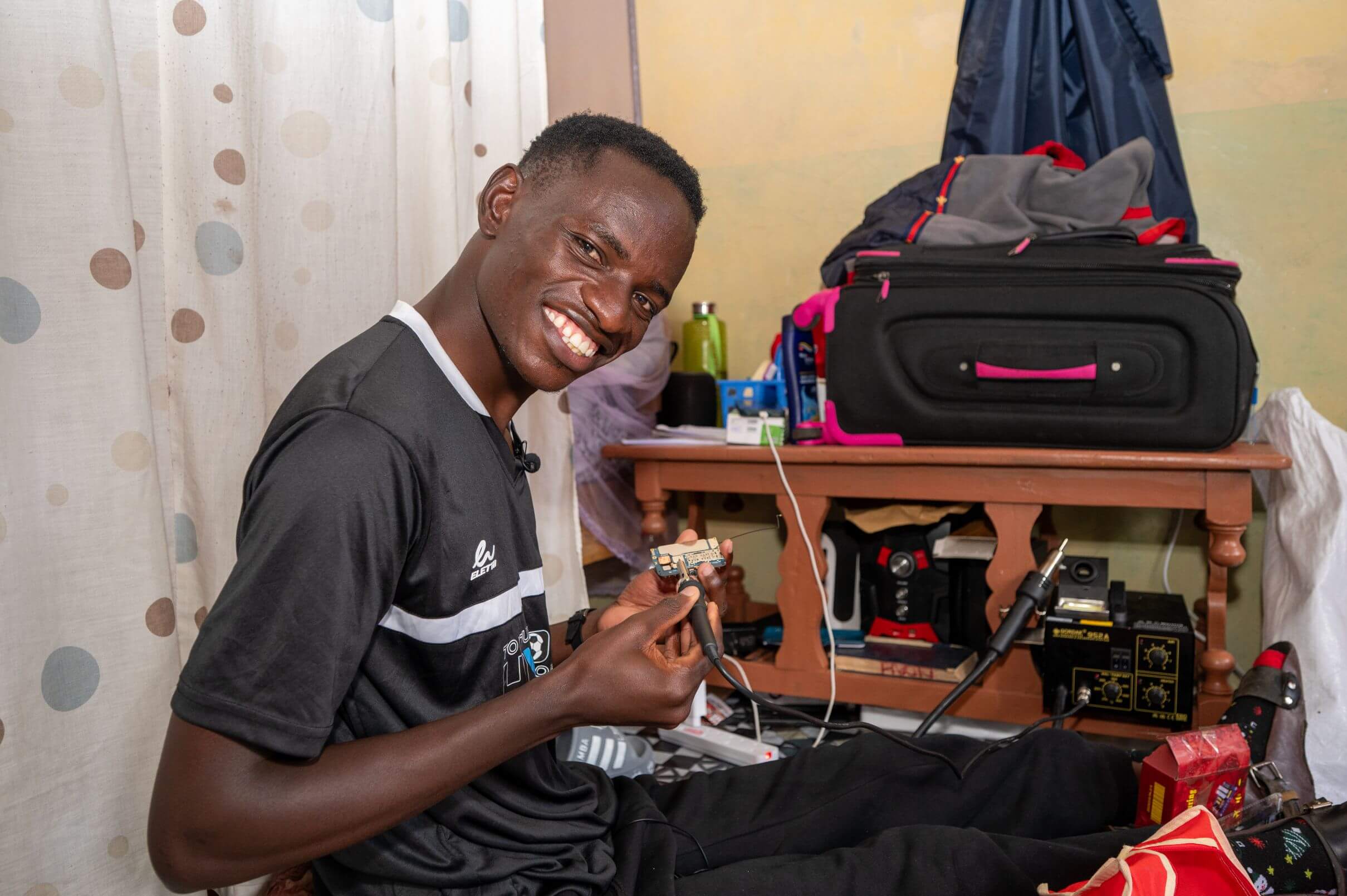
“Most people in Nakuru do not call me Noah Matara anymore. They call me the phone technician. On TikTok, I use the name Peace Rising Soul Electronics Fundi wa Simu. When someone’s screen breaks or a phone refuses to switch on, there is a good chance my name comes up in the conversation.
“A few years ago, that would have been difficult for me to imagine. Football was a big part of my life growing up. I had sponsors supporting me through high school, and a technical institution offered me an opportunity to continue my education after Form Four (the final year of secondary school in Kenya). I thought I knew what the next chapter of my life would look like.
“Then an accident changed those plans. I lost opportunities that I had worked hard for, and for a while, I spent a lot of time wondering what would come next. Eventually, I stopped asking myself what I had lost and started asking what I could still build. That question led me to electronics. I started thinking about business opportunities and settled on phones, chargers, speakers, radios and televisions.
“At the time, I did not know exactly where that decision would lead, but I knew I needed to start somewhere.”
Learning the e-waste repair trade
“A year later, a cousin invited me to Nakuru. It was there that I met Bishop Ben Ng’ang’a of Chosen Generation Church. When he asked me what I wanted to do, I told him I wanted to work with phones and electronics. Instead of directing me towards selling them, he introduced me to someone who could teach me how to repair them. I spent the next year and a half learning the trade.
“Repairing phones was not simply about learning a technical skill. It gave me a way of seeing a future for myself again. When I heard about the Power Up programme, I saw another opportunity to learn. The training expanded my knowledge beyond phone repairs and exposed me to repairing laptops, radios and televisions as well.
“As my knowledge grew, so did my confidence in the work I was doing. Using income from repairs, I bought a hot air blower, phone covers, screen protectors and other tools that helped me improve the quality of my services.”
Growing an e-waste business
“Today, social media plays a big role in the growth of my business. I regularly post repairs I have completed and share examples of my work. Customers share those posts with friends, neighbours and family members, and many of the people who contact me do so because somebody recommended me.
“One customer came to me after seeing a neighbour share one of my posts online. After I repaired her phone screen, she smiled and told me she finally believed I was a real technician. I still think about that interaction. Not because of the compliment itself, but because it reminded me how important trust is in this business. Every repair matters. Every job helps me meet my daily needs, invest in better tools and improve the quality of my services.
“The business did not become profitable overnight. Before phone repair generated enough income, I made and sold liquid soap. Some months, paying rent felt like a bigger challenge than repairing phones. I have encountered barriers along the way. I have lost opportunities after employers learned that I use a wheelchair, and public transport has not always been accessible. Those experiences are real, but they are not the whole story.
“What I know is that if I had remained at home, I would never have learned phone repair. I would never have met the people who supported me. I would never have discovered a skill that now provides my livelihood. That belief shapes the advice I give other persons with disabilities: ‘Do not let fear make decisions for you. If there is an opportunity to learn, take it. If there is a skill you want to develop, pursue it.’”
Inspiring the next generation of e-waste entrepreneurs
“These days, I spend a lot of time thinking about the future. My goal is to train up to ten people at a time and help them build livelihoods through electronics repair. I want to reach a point where the people I train manage repairs while I focus on growing the business and creating even more opportunities.
“I believe what I am doing today is only the beginning. In the next two to five years, many people will be amazed by what they see.”
Aaron’s story: from repair technician to e-waste mentor
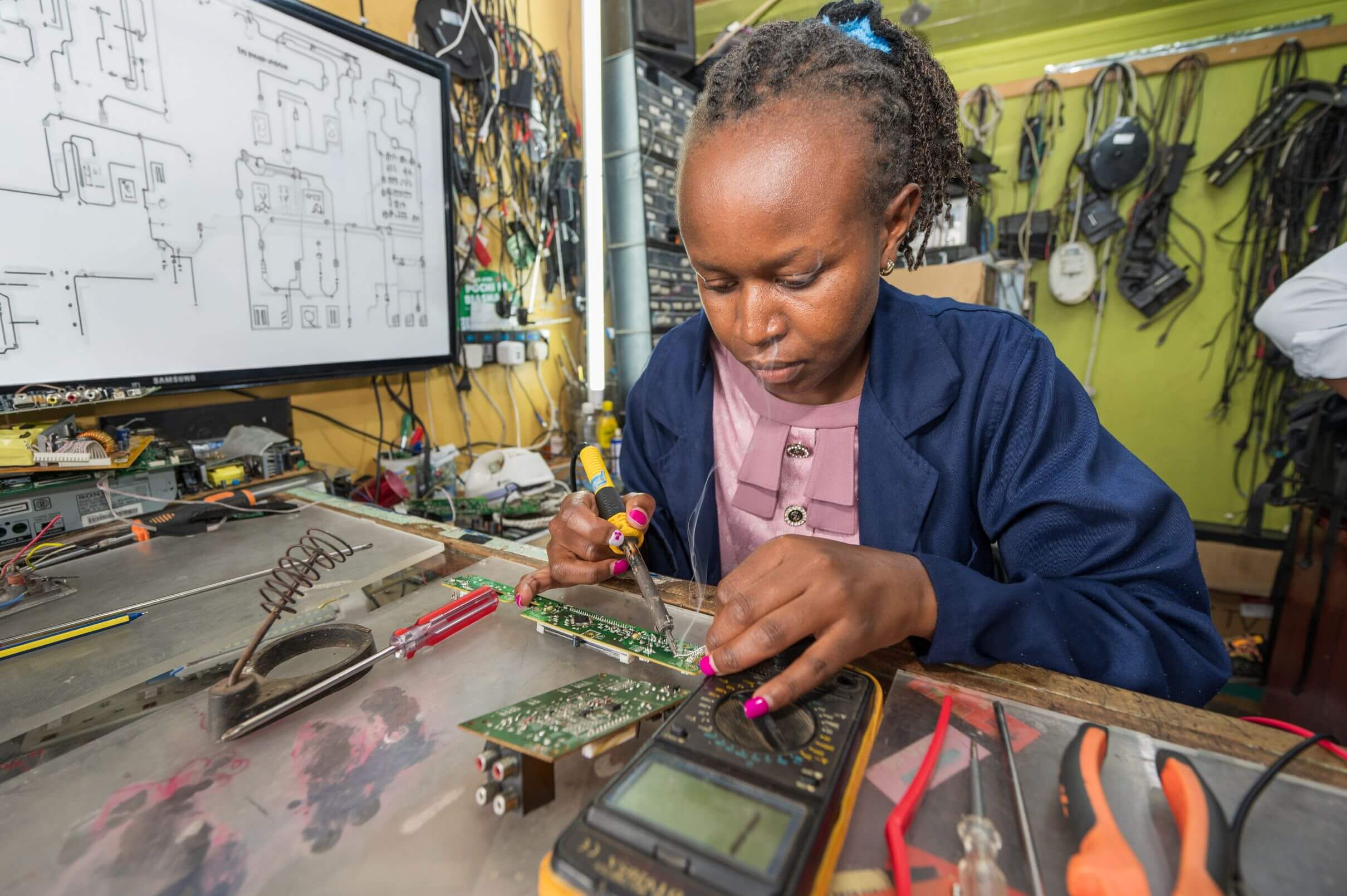
The steady hum of televisions, microwaves and subwoofers fills Aaron Masia’s repair shop in Langalanga, Nakuru. For Aaron, this shop is more than a business. It represents growth, discipline and an opportunity to give others the same chance he once received.
Aaron has worked as a technician for nearly 11 years, repairing household appliances such as TVs, microwaves, subwoofers and other household electronics. His journey started after school, when he found a mentor to train him in repair work. After gaining experience, Aaron opened his own business and steadily built a name for himself in Nakuru.
Although he had years of technical experience, Aaron identified gaps in his skills before joining the PowerUp Programme.
“Sometimes a customer would bring work that I did not fully understand, especially phones or laptops that required tools or software skills I did not have. I would end up referring the work elsewhere because I could not complete it myself,” he says.
Growing a business — and inclusion
Among the many lessons from the programme, two areas influenced Aaron’s perspective the most: inclusion and marketing.
For the first time, Aaron intentionally considered how his business could serve a wider range of customers and create a more inclusive environment.
“We were encouraged to learn simple sign language and think about how people using wheelchairs or those with visual impairments can also access our services,” he says.
“It opened my eyes to realise they are also important clients, and small adjustments in my business can make a big difference.”
Inspired by the training, Aaron created a business logo and started promoting his work consistently through WhatsApp, Facebook and TikTok.
“I began posting the kind of work I do together with my phone number. New customers started calling and saying they had seen my work online. Even my regular clients now repost my statuses and refer me to others,” he says.
“Before the training, I saw myself as just a technician. I would open and close the shop whenever I wanted, and I did not keep records. But the programme taught us to take our businesses seriously and handle clients professionally.”
Sharing skills and passing on knowledge
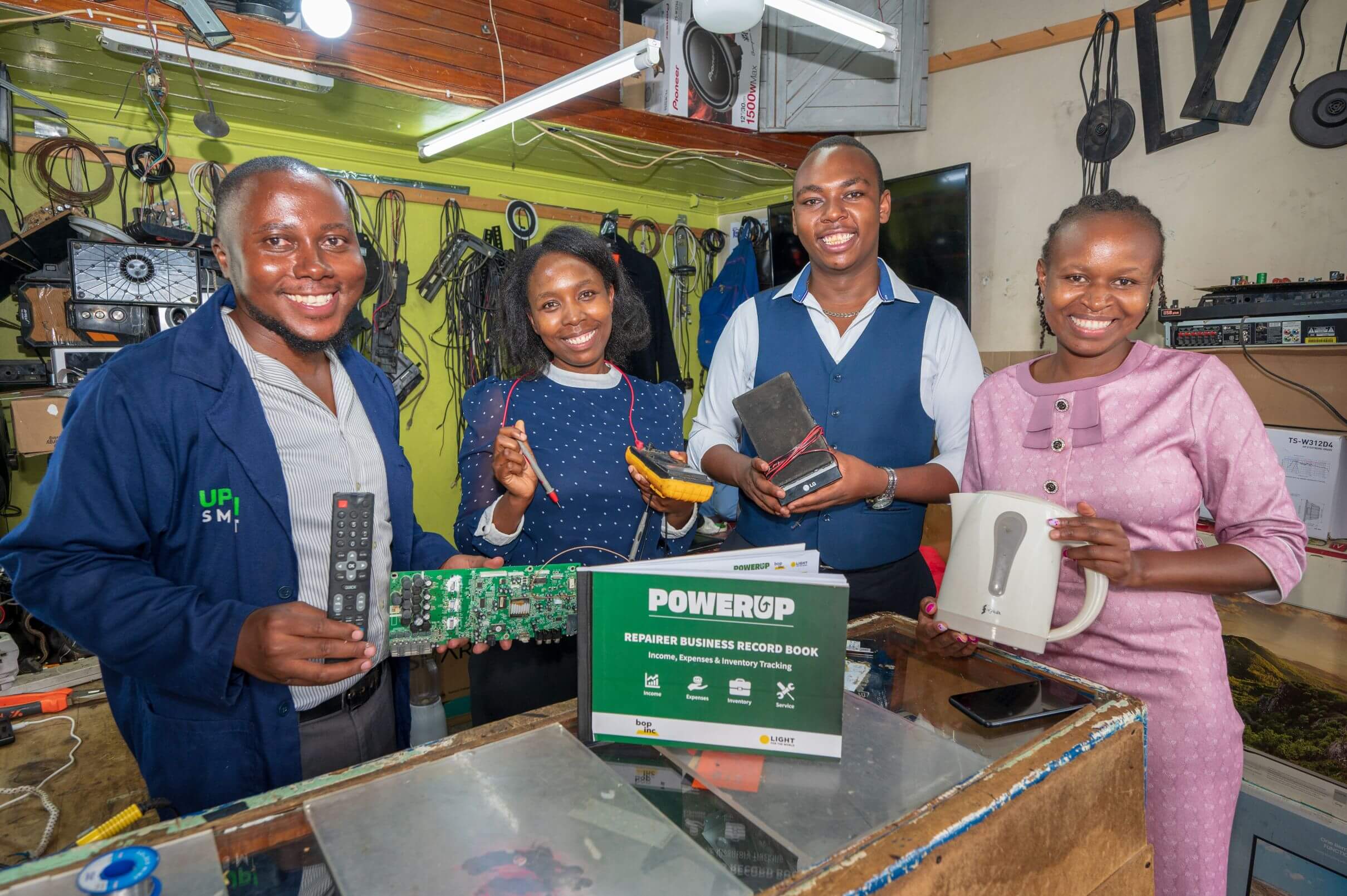
Aaron now has a commitment to mentoring others. Today, he guides three interns in his workshop.
“The programme motivated me to share whatever I have learned with others. When we work together, I also refresh my own skills and continue learning. It has become a good experience for all of us,” he says.
One of the interns he mentors is Jane Waweru, a mother of three who joined the PowerUp Programme seeking a new direction in life.
“Before joining the programme, I was doing business just to earn an income, but it was not something I truly loved. Even marketing myself was difficult because I felt like I was in the wrong space,” Jane says.
“Aaron’s experience over the past 11 years motivated me to learn from him because he has a lot of knowledge and skills in this field.”
Jane has since learned practical repair skills and started earning income from her work.
Aaron hopes to continue growing his business and acquiring more advanced tools to serve more customers and train the next generation of technicians.
“The PowerUp Programme has been a game-changing experience for me. It taught me how to manage money, interact with clients professionally and grow my business with purpose,” Aaron says.
“I believe if more young people had access to such opportunities, it would transform many lives.”